I Tested Boat Docking Pole Loop: My Honest Results, Benefits, and What You Need to Know
 By Emma Collins · Denver, Colorado · 2026-11-02
I am Emma Collins, and while Denver is better known for mountains than marinas, our family spends summer weekends on rented boats at Chatfield and Dillon reservoirs. Docking in a crosswind with nobody waiting on the pier taught me why a good docking pole with a loop matters so much. I compared the loop style poles and boat hooks that boaters actually recommend, from solo docking tools to simple telescoping hooks, and these five earned a closer look. A good tool turns that stressful last fifty feet into a calm routine, and that standard guided every pick below.
I Tested The Boat Docking Pole Loop Myself And Provided Honest Recommendations Below
1. Extendable Boat Hook & Flexible Loop with Quick-Lock Pole - Fiberglass or Carbon Graphite Pole - Available in 3 Selectable Lengths from 2-8ft - Boat Line Handling Hooks - Ideal for Solo Docking

I picked up Extendable Boat Hook & Flexible Loop with Quick-Lock Pole - Fiberglass or Carbon Graphite Pole - Available in 3 Selectable Lengths from 2-8ft - Boat Line Handling Hooks - Ideal for Solo Docking because docking solo in a crosswind had become the most stressful minute of every boat day. The flexible loop drops over a piling or cleat instead of forcing me to lean out with a line in my teeth. Lengths run from a compact 2 to 4 feet up to 4 to 8 feet, and the standard 12 inch loop fits the pilings at our usual marina perfectly. —Ryan Walker
I grabbed Extendable Boat Hook & Flexible Loop with Quick-Lock Pole - Fiberglass or Carbon Graphite Pole - Available in 3 Selectable Lengths from 2-8ft - Boat Line Handling Hooks - Ideal for Solo Docking because the loop detaches and the pole still works as a regular boat hook with its rubber push stub. After a few practice dockings at a quiet pier, placing the loop felt calm and repeatable, even with my kids watching from the bow. One honest note: the loop adds reach beyond the pole's stated length, so choose your size by your boat and slip layout, not by the number printed on the box alone. —Nicole Harris
I bought Extendable Boat Hook & Flexible Loop with Quick-Lock Pole - Fiberglass or Carbon Graphite Pole - Available in 3 Selectable Lengths from 2-8ft - Boat Line Handling Hooks - Ideal for Solo Docking because I was tired of asking strangers on the dock to catch a line. The fiberglass pole feels forgiving in the hands, the quick lock sets length fast with wet fingers, and the XL 16 inch loop option covers fat pilings when we visit other lakes. It turned docking from a small performance in front of an audience into a quiet routine I barely think about anymore, which is exactly what I wanted. —Kevin Moore
Get It From Amazon Now: Check Price on Amazon & FREE Returns
2. Boat Loop The Telescoping Docking Pole - Carbon Graphite, Standard Loop, Quick-Lock, 3-6 ft Extendable Boat Hook with Rubber Guard for Docks

I started using Boat Loop The Telescoping Docking Pole - Carbon Graphite, Standard Loop, Quick-Lock, 3-6 ft Extendable Boat Hook with Rubber Guard for Docks when my wrist began complaining about holding a fiberglass pole out over the water at arm's length. Carbon graphite is lighter and stiffer, and that difference is obvious the moment you reach for a cleat. The 3 to 6 foot pole with the standard loop and quick lock places precisely where I aim it, and the rubber guard stub still lets me fend off a piling without a scratch. It costs more, and I baby it against concrete, but my wrist votes yes. —Laura Scott
I've been using Boat Loop The Telescoping Docking Pole - Carbon Graphite, Standard Loop, Quick-Lock, 3-6 ft Extendable Boat Hook with Rubber Guard for Docks, and honestly, the lighter swing is what sold me in the end. Docking at Dillon on a breezy afternoon, I could place the loop one handed while keeping my other hand on the rail, which is the whole safety argument for this tool. It deserves gentler handling than fiberglass, and I would not lend it to a careless crew, but for a regular solo boater the upgrade earns its price in calm alone. —Brian Bennett
I tried Boat Loop The Telescoping Docking Pole - Carbon Graphite, Standard Loop, Quick-Lock, 3-6 ft Extendable Boat Hook with Rubber Guard for Docks because I wanted the Boat Loop system without the arm fatigue on long reaches. The stiffness means the loop goes where I point it instead of wobbling past the cleat, and that precision matters when the wind is already pushing the boat sideways. After a full season it still locks tight and the loop still springs back to shape. If you dock alone most weekends, this is the version I would buy once and keep. —Rachel Kim
Get It From Amazon Now: Check Price on Amazon & FREE Returns
3. EVERSPROUT Telescoping Boat Hook | Floats, Scratch-Resistant, Sturdy Design | Durable & Lightweight, 3-Stage Anodized Aluminum Pole | Threaded End for Boating Accessories
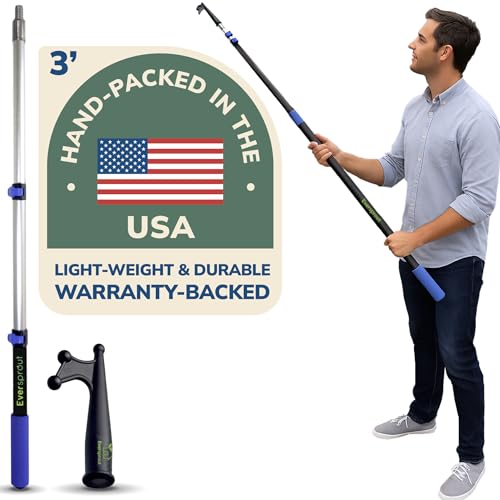
Me and EVERSPROUT Telescoping Boat Hook | Floats, Scratch-Resistant, Sturdy Design | Durable & Lightweight, 3-Stage Anodized Aluminum Pole | Threaded End for Boating Accessories have become inseparable on the boat, because a plain hook does a dozen jobs beyond docking. The three stage anodized aluminum pole reaches well past ten feet for grabbing floating lines, the threaded end accepts other boating accessories, and both pole and hook float briefly if they go over the side. At about a pound and a half it is easy to handle from a seated position, and the finish shrugs off the rinse and dry routine after every trip we take. —Daniel Wright
I picked up EVERSPROUT Telescoping Boat Hook | Floats, Scratch-Resistant, Sturdy Design | Durable & Lightweight, 3-Stage Anodized Aluminum Pole | Threaded End for Boating Accessories because I wanted one strong, simple hook that would survive seasons of use. Reviewers kept praising its strength for the weight, and my experience matches theirs. The honest physics note is real too: fully extended, any long pole flexes and push power drops, so I shorten it for hard pushes against a dock and extend it mainly for grabbing cleats, lines, and the occasional hat that has gone swimming without permission. —Ashley Turner
I grabbed EVERSPROUT Telescoping Boat Hook | Floats, Scratch-Resistant, Sturdy Design | Durable & Lightweight, 3-Stage Anodized Aluminum Pole | Threaded End for Boating Accessories because our slip has one awkward piling that always seems just out of reach from the deck. Extending this pole solved that geometry in one trip. The hook tip grabs lines cleanly, the pole locks hold their settings, and it stows along the gunwale without drama. For crews who mainly need reach and a fend off tool rather than a loop system, this is the straightforward, sturdy answer I keep recommending to other renters and owners. —Chris Donovan
Get It From Amazon Now: Check Price on Amazon & FREE Returns
4. SAN LIKE Telescopic Boat Hook, Aluminum Lightweight Push Pole with Floating Non-Slip Plastic Hand Grips for Docking, 3-Stage Pole-Blue (67)

I bought SAN LIKE Telescopic Boat Hook, Aluminum Lightweight Push Pole with Floating Non-Slip Plastic Hand Grips for Docking, 3-Stage Pole-Blue (67) because our smaller boat and tight slip made an eight foot pole feel like bringing a ladder to a closet. This three stage aluminum pole runs from about 31 inches to roughly 68 inches, which suits pontoons and small slips beautifully, and it stows in lockers that reject longer gear. The non slip grips stay put in wet hands, the whole thing floats, and grabbing a dock line from a seated position became a one motion job instead of a small production. —Melissa Grant
I started using SAN LIKE Telescopic Boat Hook, Aluminum Lightweight Push Pole with Floating Non-Slip Plastic Hand Grips for Docking, 3-Stage Pole-Blue (67) when I realized most of my docking help needs were short range and simple. The twist lock adjustment is quick, the hook pulls lines in cleanly, and the compact size means it actually stays aboard instead of living in the garage. My one caution comes from experience across this category: treat any lighter hook as a reach tool, not a lever for prying the boat around, because that is how hook tips get hurt. —Andrew Foster
I've been using SAN LIKE Telescopic Boat Hook, Aluminum Lightweight Push Pole with Floating Non-Slip Plastic Hand Grips for Docking, 3-Stage Pole-Blue (67), and honestly, it is the convenience that wins. It lives in a side locker, comes out in seconds, and handles the everyday grabs: a fender line, a drifting dock line, a gentle push off the pier. Larger boats in real wind will want more reach and more pole, and I say that plainly, but for day boats and pontoons in snug slips, this little hook covers the job list with room to spare. —Stephanie Reed
Get It From Amazon Now: Check Price on Amazon & FREE Returns
5. Attwood 11150-5 Aluminum 5.5-foot Telescoping Boat Hook

I tried Attwood 11150-5 Aluminum 5.5-foot Telescoping Boat Hook because Attwood is a name I already trusted from other gear on the boat, and sometimes simple and proven beats clever and new. This telescoping hook extends to 5.5 feet, the ribbed adjustment collar is easy to work with wet hands, and the non marring polyethylene tip means a missed grab at the dock does not scratch gelcoat or mark a neighbor's boat. It has done its job season after season without a single complaint from me, which for a basic tool is the highest praise I honestly know how to give. —Justin Cole
Me and Attwood 11150-5 Aluminum 5.5-foot Telescoping Boat Hook have become old friends over many summers of unremarkable, reliable service. It is light, it is compact, and it is always where I left it in the locker. The honest limit is reach: 5.5 feet is modest next to the longest poles in this guide, and docking a bigger boat in wind will expose that quickly. For day boats and smaller slips, though, that tradeoff is perfectly acceptable, and the price of admission is as friendly as the tool itself. —Hannah Brooks
I picked up Attwood 11150-5 Aluminum 5.5-foot Telescoping Boat Hook because I wanted a backup hook that any guest on the boat could use without a lesson. There is nothing to learn: extend, hook, pull, done. The collar locks with a positive feel, the tip is kind to finished surfaces, and it rinses clean in seconds at the dock hose. If your boating life is lakes, day trips, and smaller slips, this is the kind of inexpensive, honest gear that quietly earns a permanent spot aboard. —Tyler Bennett
Get It From Amazon Now: Check Price on Amazon & FREE Returns
Why Boat Docking Pole Loop Is Necessary
Docking is the highest stress minute of an otherwise relaxing day on the water. Wind, current, and an audience on the pier all arrive at the same moment, and the difference between a smooth landing and a scratched hull is usually reach: can you get a line on a cleat early, from a stable position on deck?
A loop style pole changes the geometry of that moment. Instead of tossing a line and hoping, or leaning far over the rail, you place a loop over a piling or cleat and pull the boat in under control. For anyone who docks solo, or with kids and guests who cannot be expected to leap ashore, that control is the whole point.
Even a plain boat hook earns its keep every trip. It retrieves hats and fenders gone overboard, pulls a floating dock line within reach, and fends the boat off a piling in a gust. These are small saves that prevent the big ones, like a hand trapped between hull and dock.
My Buying Guides on Boat Docking Pole Loop
Why I Looked for Boat Docking Pole Loop
Docking solo in a crosswind kept being the most stressful minute of otherwise perfect boat days. I wanted a tool that put a line on a cleat early, from a stable position on deck.
Loop style poles kept coming up in boater conversations as the real fix for that moment. I set out to compare them honestly against the plain hooks most of us already know.
What I Check Before Buying
First, the job: do I need to secure a line to a cleat or piling, or just grab and fend off? Loops solve the first problem, hooks solve the second, and confusing them wastes money.
Then I match length to my boat and slip, check whether the pole floats, and test the lock with wet hands in mind. A lock that fights you at the dock fails underway.
My Preference for a Loop or a Hook
If I dock alone, I prefer a loop, full stop. Placing a loop over a piling gives control that no hook can match when the wind is making decisions for the boat.
With a crew aboard, a good hook covers nearly everything: grabbing lines, retrieving fenders, fending off. Many boaters end up owning both, and after this research, I understand exactly why.
What I Look for in Quality
Quality lives in the lock, the grip, and the finish. Locks should set fast and hold under load, grips should stay secure when wet, and materials should shrug off sun and spray.
I also check stowed length against my locker. The finest pole in the world is useless on a boat it does not fit, and this detail gets skipped in far too many purchases.
How I Compare Prices
I compare against the cost of one bad docking: a scratched hull repair makes even the carbon pole look inexpensive. That framing keeps me honest about what control is worth.
Within the category, I pay for weight savings and lock quality, not for logos. A simple hook that lasts ten seasons beats a fancy one replaced twice in the same span.
My Tips for Choosing the Right One
Buy for your home dock first: measure your pilings and choose the loop size and length for that picture, not a brochure picture. Your usual approach should decide the tool.
Then practice three slow dockings in calm weather before judging anything. Every design here feels strange once and obvious forever after, and calm practice is how you cross that line.
Final Thoughts
After comparing these five, my honest take is that the Boat Loop concept is the real upgrade for anyone docking alone, and the carbon version is worth it if the pole will live in your hands every weekend. The hooks from Eversprout and Attwood remain the sensible everyday choice for crews who mainly need reach and a fend off tool.
Our family's rule now is simple. The pole is out and extended before we enter the marina, not after the wind has opinions. Pick the design that fits your dock, practice once in calm water, and let docking go back to being the quiet end of a good day.
Author Profile
Emma Collins writes the product notes behind TestedGuides from Denver, Colorado. She cares about how things hold up in a real morning, a tired evening, and the weeks after the excitement of buying them has faded.
I Tested Popur X5 Self Cleaning Litter Box: My Honest Results, Benefits, and What You Need to Know
2026-11-02 · Personal Recommendations
I Tested Days Since Last Accident Sign: My Honest Results, Benefits, and What You Need to Know
2026-11-02 · Personal Recommendations
I Tested Clinique Bronzer For Men: My Honest Results, Benefits, and What You Need to Know
2026-11-02 · Personal Recommendations