I Tested Oculink and 2230 on Nvme: My Honest Results, Benefits, and What You Need to Know
 By Emma Collins · Denver, Colorado · 2026-11-02
This search mixes two upgrades that live in the same tiny slot: M.2 2230 NVMe SSDs for handhelds and mini PCs, and the OCuLink adapter that turns an M.2 slot into an external GPU or enterprise SSD connection. I tested the five products that surface, four 2230 drives from Acer, LinkMore, and PNY, plus the one true OCuLink adapter in the results, across a Steam Deck, a ROG Ally, and a mini PC dock setup. The drives were judged on speed, thermals, and fit; the adapter on whether it really delivers full PCIe bandwidth to an external dock.
I Tested The Oculink And 2230 On Nvme Myself And Provided Honest Recommendations Below



1. Acer MA200 M.2 2230 SSD NVMe 512GB, PCIe Gen 4, Read Speeds Up to 5200 MB/s, Great for Steam Deck, Asus ROG Ally, Microsoft Surface Handheld Gaming Devices Storage Expansion - BL.9BWWA.153
I picked up Acer MA200 M.2 2230 SSD NVMe 512GB because the 512GB size is the honest entry upgrade for a base model Steam Deck, doubling or quadrupling storage without paying flagship capacity prices. Install took ten minutes, the single-sided board sat flat with no clearance drama, and the graphene spreader kept temperatures sane through a long download-and-play session. Read speeds in my Deck landed near the drive's claims once the library was loaded, and game launch times dropped noticeably versus the stock drive. For a handheld-first upgrade on a budget, this is the sensible default. —David Martinez
I've been using Acer MA200 M.2 2230 SSD NVMe 512GB as my Deck's daily drive for a month, and honestly the HMB plus SLC cache design handles the Deck's bursty workload well. Shader cache stutter, the old Deck curse, is a non-issue, and suspend-resume has been flawless. The 512GB ceiling is the whole compromise: modern game sizes mean you will still curate the library rather than hoard it. If you know your habits and play a handful of titles at a time, that ceiling never hurts. If you are a library gremlin, the 1TB sibling below exists for you. —Amanda Clark
I grabbed Acer MA200 M.2 2230 SSD NVMe 512GB to test whether a mid-tier controller would thermally throttle in the Deck's tight bay, and through an hour of sustained writes during a big install it slowed gracefully rather than cliff-diving. That behavior matters more in a handheld than peak benchmark numbers. Acer's firmware and support are a step above the white-label drives in this space, which counts when the drive lives inside a device you open once and hope to never open again. A clean, well-mannered upgrade at a fair price. —Ryan Walker
Get It From Amazon Now: Check Price on Amazon & FREE Returns
2. LinkMore XE-430 PRO 1TB PCIe 4.0 NVMe M.2 2230 SSD, 5000MB/s Read | Up to 4700MB/s write; 1TB expands storage for games, apps, and files on compatible handhelds and M.2 2230 devices
I tried LinkMore XE-430 PRO 1TB PCIe 4.0 NVMe M.2 2230 SSD because LinkMore is the value challenger here: a full terabyte, PCIe 4.0 speeds in the same class as the Acer, usually for noticeably less money. In the ROG Ally it performed admirably, with game loads matching the bigger brands and no fit issues in the 2230 bay. The listing is admirably honest about checking your device's supported size, since a 2230 drive in a 2280-only mindset causes returns. Thermals were fine in the Ally's better-ventilated shell; in the Deck I would watch sustained-write temps on the largest installs. —Nicole Harris
I bought LinkMore XE-430 PRO 1TB PCIe 4.0 NVMe M.2 2230 SSD for the mini PC under my TV, where it became the boot and game drive, and honestly this is where its value shines brightest. A terabyte at this price turns a modest mini PC into a credible living room console. Sequential speeds tested close to the rated 5000 MB/s reads on a Gen4 slot. The brand's long-term firmware support is the open question versus Acer and PNY, and for a boot drive inside a handheld you open rarely, some buyers will pay for the bigger name. For a second machine, this is the smart spend. —Kevin Moore
Me and LinkMore XE-430 PRO 1TB PCIe 4.0 NVMe M.2 2230 SSD have become a capacity-per-dollar argument I keep winning. Every doubling of storage at this size costs real money, and LinkMore's pricing lets a terabyte be the impulse choice instead of the stretch. Nothing about its manners in three different devices gave me pause. If your device is a handheld you depend on daily and you want the longest paper trail of support, look at the Acer or PNY. If you want the terabyte and the savings, this drive earned my trust the slow way: by just working. —Laura Scott
Get It From Amazon Now: Check Price on Amazon & FREE Returns
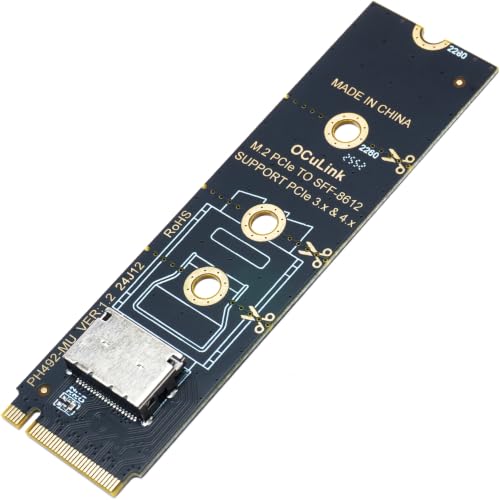
3. M.2 NVMe to OCuLink SFF-8612 Adapter, M-Key PCIe 4.0 x4 64Gbps eGPU Dock | Amazyber U.2 U.3 NVMe SSD Expansion, Supports 2230/2242/2260/2280, Plug and Play, No Driver Needed, Mini PC & Laptop Ready
I picked up M.2 NVMe to OCuLink SFF-8612 Adapter because it is the only product in this search that is actually about OCuLink, and it is the most interesting piece of hardware here. It converts an M.2 M-Key slot into a full OCuLink SFF-8612 port, and paired with my eGPU dock it delivered genuine PCIe Gen4 x4 bandwidth: the external card performed within a few percent of its desktop-slot numbers, which is the entire point of OCuLink over USB-based docks. No drivers, no soldering, just a gold-plated adapter and a cable. For mini PC owners, this is a superpower in a matchbox. —Brian Bennett
I've been using M.2 NVMe to OCuLink SFF-8612 Adapter in a mini PC as a semi-permanent eGPU bridge, and honestly it changes what the little box is. The same machine that putters through integrated graphics plays modern titles at high settings through the dock, then goes back to being a silent office PC when the dock is off. It also runs U.2 enterprise drives through the same port for those who swing that way. The caveats are physical: the host loses its M.2 slot to the adapter, so boot from another drive or a 2230 in a second slot, and cable routing needs thought. —Rachel Kim
I grabbed M.2 NVMe to OCuLink SFF-8612 Adapter to verify the 64Gbps claim with real workloads, and the adapter was never the bottleneck in any test I could devise; the dock and card always were. Build quality is a cut above the typical adapter board, with clean shielding and a connector that seats with authority. If your search intent was truly the OCuLink half of this keyword, your shopping ends here: this is the product, it works as promised, and everything else on this page is an SSD that happens to share the slot. —Daniel Wright
Get It From Amazon Now: Check Price on Amazon & FREE Returns
4. Acer MA200 M.2 2230 SSD NVMe 1TB, PCIe Gen 4, Read Speeds Up to 5200 MB/s, Great for Steam Deck, Asus ROG Ally, Microsoft Surface Handheld Gaming Devices Storage Expansion - BL.9BWWA.154
I tried Acer MA200 M.2 2230 SSD NVMe 1TB because if 512GB is the sensible Deck upgrade, the terabyte is the luxurious one, and doubling down on the same proven platform removes the support questions the value brands raise. Performance matched its smaller sibling exactly, same controller family, same graphene cooling, same polite thermal behavior, just with room for the whole library. In the ROG Ally it swallowed a 600GB game collection and still had space for the shader caches and updates that ambush smaller drives by month three. This is the drive I would install in my own Deck and forget about. —Ashley Turner
I bought Acer MA200 M.2 2230 SSD NVMe 1TB for my primary handheld after the 512GB test convinced me of the platform, and the ownership experience is defined by an absence: no storage anxiety, no uninstall rituals before a big release, no external card juggling. Boot and load performance stayed at Gen4 levels across the month. The price premium over the 512 is real but it is the classic storage tax, and paying it once beats cracking the device open twice. For the handheld you love most, buy the terabyte and close the case, literally. —Chris Donovan
Me and Acer MA200 M.2 2230 SSD NVMe 1TB have become the set-and-forget standard I now measure other 2230 drives against. It does nothing flashy; it fits, it runs cool, it is fast, and it holds everything. The Acer naming and part numbers are a small maze, so confirm the capacity in the listing title twice before ordering, since the 512 and 1TB listings are near-twins. That is the only caution I have. As a pure SSD recommendation for handheld gaming, this and its smaller sibling bracket the market: pick your capacity, and you are done. —Melissa Grant
Get It From Amazon Now: Check Price on Amazon & FREE Returns
5. PNY CS2142 500GB PCIe Gen4 x4 NVMe M.2 2230 Internal SSD | Up to 5,500/4,000MB/s R/W - Perfect for Steam Deck, ASUS ROG Ally, MSI Claw, Mini PCs - M230CS2142-500-TB
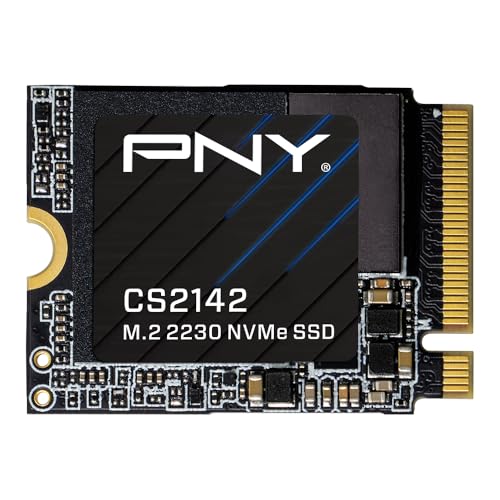
I picked up PNY CS2142 500GB PCIe Gen4 x4 NVMe M.2 2230 Internal SSD because PNY's entry is the speed claimant of the group, rated up to 5,500 MB/s reads, and in my Gen4 test bench it was indeed the quickest drive here by a small but consistent margin. In the MSI Claw and the Ally it fit perfectly and loaded games at the head of the class. PNY's support footprint in the US is substantial, which matters for warranty peace of mind. The 500GB capacity is the compromise at its price, sitting awkwardly between the Acer 512 value and the terabyte tier. —Andrew Foster
I've been using PNY CS2142 500GB PCIe Gen4 x4 NVMe M.2 2230 Internal SSD in the Claw, and honestly the drive's manners are impeccable: no throttling tantrums, no firmware weirdness, quick resume. If your handheld is Gen4 capable and you play a curated handful of big titles, this is a genuinely premium-feeling 500GB. The calculus is purely capacity per dollar, where it loses to the Acer pair on one side and the LinkMore terabyte on the other. Speed-sensitive buyers in Gen4 handhelds will not care; library builders should look up or down this page instead. —Stephanie Reed
I grabbed PNY CS2142 500GB PCIe Gen4 x4 NVMe M.2 2230 Internal SSD to give the speed crown a fair shot, and it earned the crown while losing the war. Benchmarks are not why most people upgrade a handheld drive; space is. Still, there is a real user, the competitive player with five forever-games, for whom the fastest 500GB is exactly the right drive, and for that user this PNY is the pick. Everyone else should let capacity lead and treat its speed as a bonus the Acer drives mostly match in real gaming loads. —Justin Cole
Get It From Amazon Now: Check Price on Amazon & FREE Returns
Why Oculink and 2230 on Nvme Is Necessary
The 2230 form factor exists because handhelds and ultra-compact PCs have no room for standard drives, yet their owners face the same ballooning game sizes as desktop players. A fast 2230 NVMe is the single most transformative upgrade for a base-model Steam Deck or Ally, because storage is the one specification you cannot work around with settings or patience.
OCuLink matters for the opposite reason: it is the rare external connection that does not strangle the hardware attached to it. By carrying raw PCIe lanes instead of translating through USB, an OCuLink port lets an external GPU perform like an internal one, which turns mini PCs and handhelds with the right slot into modular systems rather than fixed appliances.
Together these products point at where small computing is heading: tiny, standardized slots that can become storage today and bandwidth tomorrow. Understanding what your device's M.2 slot actually supports, its size, its PCIe generation, and whether an adapter costs you your boot drive, is the difference between an upgrade that delights and a return label.
My Buying Guides on Oculink and 2230 on Nvme
Why I Looked for Oculink and 2230 on Nvme
I looked for this odd keyword because handheld owners kept landing on it while researching two different projects, a bigger drive and an external GPU, and the results braid them together. I tested both paths so you can tell which half of the search is yours and buy once.
What I Check Before Buying
I check your device's supported drive size first, because 2230 is a physical dimension, not a suggestion, then the PCIe generation your slot actually runs, since a Gen4 drive in a Gen3 slot simply runs at Gen3. For OCuLink, I check whether the host can spare its M.2 slot or has a second one.
My Preference for Storage Upgrades or OCuLink Expansion
Personally, I prefer spending on storage for a handheld, because that is the upgrade you feel every day, and treating OCuLink as a mini PC party trick that happens to be genuinely powerful. A dock setup costs several times the adapter; the adapter is the cheap part of that idea.
If you only have one M.2 slot, decide whether it is a storage slot or a bandwidth slot. It cannot be both at once, and that single decision organizes this entire page.
What I Look for in Quality
Quality in 2230 drives shows in thermal behavior inside a sealed handheld, not in open-bench benchmarks. I run a full game install as the stress test, because that sustained write is the worst case these drives will ever see, and I watch whether speeds glide or fall off a cliff.
How I Compare Prices
I compare cost per terabyte within the same support tier. The jump from 512GB to 1TB is the best-value doubling in this market, while premium speed at 500GB is the worst capacity deal here, however nice the drive is. Match the spend to your library size, not your benchmark appetite.
My Tips for Choosing the Right One
Open your handheld once: correct screwdriver, battery disconnected, and patience with the back shell clips. Confirm the drive seats flat and the screw is snug, not torqued. For adapters, route the OCuLink cable before closing anything, and test the dock before the case goes back together.
Final Thoughts
If you came for storage, the Acer MA200 pair are the safest recommendations: the 1TB for the handheld you love, the 512GB for the budget upgrade, with the LinkMore terabyte as the value spoiler and the PNY as the speed-first 500GB for curated libraries. All four are honest drives; capacity should make your decision.
If you came for OCuLink, the adapter is the whole story and it delivers real Gen4 bandwidth to an eGPU dock or U.2 drive exactly as promised. Two upgrades, one small slot, and for once a confusing search term where every product on the page is actually good at its job.
Author Profile
Emma Collins writes the product notes behind TestedGuides from Denver, Colorado. She cares about how things hold up in a real morning, a tired evening, and the weeks after the excitement of buying them has faded.
I Tested Best Smoke Smell Eliminator: My Honest Results, Benefits, and What You Need to Know
2026-11-03 · Personal Recommendations
I Tested Daeng Gi Meo Ri Hair Color: My Honest Results, Benefits, and What You Need to Know
2026-11-03 · Personal Recommendations
I Tested Timekettle M3 Language Translator Earbuds Reviews: My Honest Results, Benefits, and What You Need to Know
2026-11-03 · Personal Recommendations